
PRODUCTIVITY HAS A PEOPLE PROBLEM
For years, the UK has searched for the missing piece of its productivity puzzle. We believe it is wellbeing, and in the age of AI it matters more than ever.
How we got here
Humans have always tried to get more done. Here is the story, from hunting for food to working alongside AI. Tap the image to explore the interactive version.
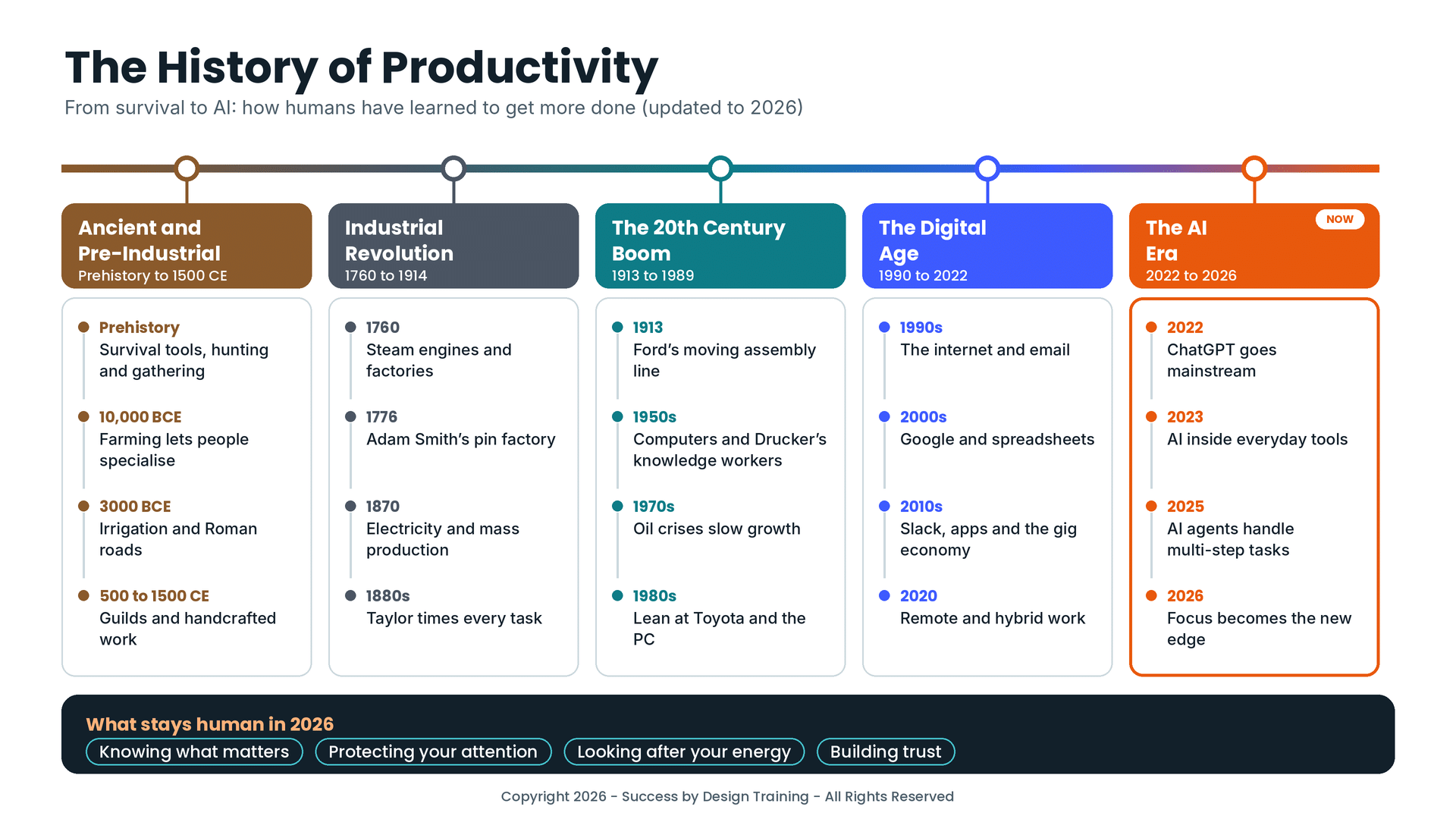
Timeline of productivity from ancient times to the AI era in 2026
The UK and productivity
Productivity simply means how much we produce for each hour we work. For many years, the UK has been said to have a “productivity problem”. Researchers, businesses and governments have all tried to explain why growth has been so slow.
One of the best known studies was by McKinsey & Company in 2018, which looked at why the UK had such low productivity growth. Read the McKinsey report.
In 2026, the picture is mixed. Some of the latest figures suggest things are improving. But even the experts disagree on how to measure it. The Office for National Statistics now recommends a different measure from the one it used before, because its main survey data has had quality problems since the pandemic.
Whichever way you count it, output still depends on people. Tools cannot fix a team that is exhausted, distrustful or disengaged.
Wellbeing is the missing piece
Our belief is backed by research. Economists at Warwick University, including Professor Daniel Sgroi and Dr Christopher Roth, study how behavioural economics shapes wellbeing for individuals and for whole countries.
In a well known Warwick study on happiness and productivity, by Andrew Oswald, Eugenio Proto and Daniel Sgroi, happier workers were around 12 per cent more productive in laboratory experiments. In plain English: people who feel well do better work.
Warwick research on wellbeing and the paper on happiness and productivity.
The trust test
When the UK went into lockdown in 2020, organisations sent people home almost overnight. It became the biggest experiment ever into whether we can trust people to work from home.
Some organisations welcomed the change and gave their teams more options and support. Others installed software to track when people were online, and a whole industry grew up to help people look active when they were not.
Years on, the argument of “back to the office” versus “work from anywhere” is still going. Neither side is asking the bigger question: are our people well, trusted and skilled enough to manage their own time?
AI changes the question
AI can now draft, summarise, sort and schedule in seconds. That is brilliant, but it raises a new question. If work gets faster, who benefits?
Without wellbeing, faster work just means more work, and people burn out quicker. The people and organisations that thrive in 2026 will be the ones who use AI to protect time and energy, not to squeeze out more hours.
Speed is now cheap. Clarity, judgement and energy are what make the difference.
Why productivity declines
Support
People who feel looked after, mentally and physically, have more to give.
Empower
People who are trusted to own their time make better decisions.
Train
Time management, resilience and flexibility are skills, and skills can be taught.
Productive Wellbeing: a fresh perspective
Your workforce is your greatest asset. Giving people the tools and strategies to stay mentally and physically well helps them be more productive, because it aligns with their integrity, which matters more to them than free snacks, vouchers, perks and bonuses.
When people work from their core values and have the skills to excel, you do not need to keep rewarding them to perform. Self-leadership simply feels better. And their salary already reflects their market value.
Productive Wellbeing is the modern work-life balance: great results in the margins of life.
WHERE TO GO NEXT
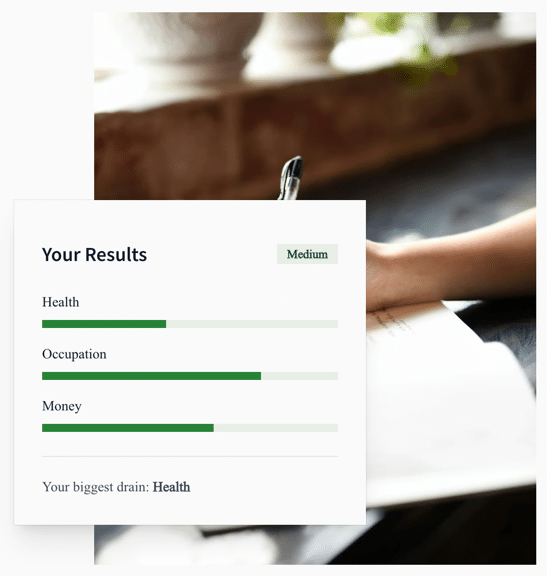
You’re doing all the right things, so why does something still feel off? Find out in 3 minutes which area of your life isn't working.
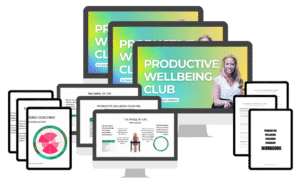
Join the Productive Wellbeing Membership, a community for ambitious professionals and entrepreneurs who want results without burning out.

Prefer to talk it through? Chat with Abigail about coaching for you, or about training and speaking for your team or event.
I loved the ‘Find Your Missing Hour’ challenge! As well as the great videos with nuggets of wisdom to make life easier and question what I am doing, and why I am doing it, there was much more. In just doing a time audit each day, it allowed me to focus on what my real priorities were. I have also changed a few things, such as writing up my ’to do’ list of an evening, ready for the morning, so I wake up and the rubber hits the road as soon as I start. Thank you so much, Abigail!
Sara Challice
The Productive Wellbeing Show and the development of The 888 Formula and challenge are both inspiring and encouraging for those looking to make more meaningful use of their work and personal time.
Lorraine Bellamy
Abigail has organised a wonderful mix of inspirational speakers who in such a small time-frame have delivered some great life experiences, advice and top-tips for self-improvement. All episodes are on YouTube and highly recommended!
Personal favourites were Dinah Liversidge on re-framing your thinking; Lucy Brazier on how to drive forward in career with your personal profile; and Libby Moore on spirituality and working for Oprah!
Fantastic job, Abigail – you’ve made lockdown somewhat of a Positive Productivity Party!
Abigail Barnes and her 888 formula gave me one of the biggest 'ah-ha' moments that I have had in recent years. As an event producer and owner of a speaker bureau, that doesn't happen very often, but Abigail's story connected and resonated, not just with me but with every audience we put her in front of. I have worked with Abigail since 2020 on various events that we have run and we always get high scores for her in our feedback. I have also guested on a couple of her shows. Abigail is always an absolute pleasure to work with, is popular with our audiences and her messaging is quite literally life-changing. I wouldn't hesitate to recommend her.
Lucy Brazier OBE